🌱 This week at Red Ants Farm
The rain's back, the days are turning, and still no lambs.
The mud has returned. So has the rain, and the head torch, and the gumboots that gave up being waterproof somewhere around Queen's Birthday. But the days are getting ever so slightly longer now — you can just about feel it in the afternoon — and that's the bit I'm hanging onto.
Still no lambs. They'll come when they come.
So this week's been the feeding and the fussing: keeping the ewes going, and trying to keep the paddocks producing — or at least in good enough shape that they're ready to go when spring turns up. Because it is around the corner. At least that's what I keep telling myself, standing in the wet at 6:20 in the morning.
Which is exactly what this issue is about: how you actually know whether a paddock is ready, instead of guessing at the gate like I did for years.
🌾 This week's topic
When is a paddock actually ready? The plant will tell you.
Here's the honest version of what most of us do: look over the gate, decide it looks about right, put the stock in. Or count days — "that one's had three weeks off, that'll do."
Days are a proxy, and in July they're a poor one. A paddock rested 25 days in a cold wet winter is not the same paddock as one rested 25 days in a warm October. The calendar doesn't know what the weather's been doing. So here's what the people who study this actually go on — and the best tool is free.
1. The three-leaf check — no gear, no cost, two minutes.
Perennial ryegrass can only hold three live leaves per tiller. When the fourth appears, the first one dies. So the plant keeps its own score, and you can read it:
- Around 2.5–3 leaves is the sweet spot. The plant has rebuilt its reserves, and you're getting the most feed at the best quality.
- Grazed at 1–2 leaves — you get less feed and it grows back slower next time, because the plant never got to recharge.
- Left past 3 leaves — the bottom leaf is dying. You're accumulating waste, not feed.
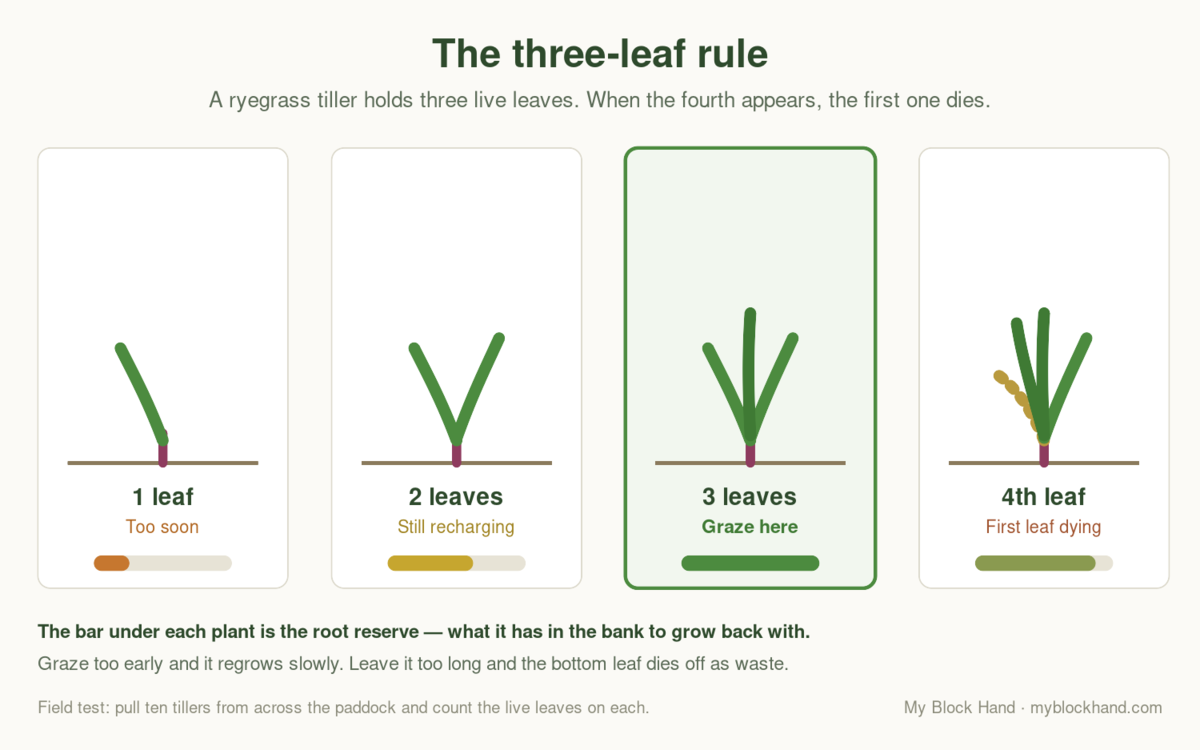
How to do it: walk across the paddock and pull about ten ryegrass tillers from different spots (they're the ones with the reddish-purple base). Count the live leaves on each and average them. That's your answer.
The bar under each plant in the picture is the bit that clicked for me: it's the plant's root reserve. Graze at one leaf and you're taking the feed and the fuel it needed to grow the next lot. That's why an over-grazed paddock takes so much longer to come back than it feels like it should.
It quietly grades your whole rotation, too. Consistently walking stock into 4-leaf pasture means your round is too slow for how fast it's growing. Consistently 1.5 leaves means you're coming back too fast, and you're wearing the paddock out a bit more each round.
2. What you leave behind — the residual — decides how fast it comes back.
This is the bit I didn't understand for far too long. The number that matters most isn't how long the paddock rests. It's how hard you grazed it before you walked away.
Take it below what the plant needs and you've cut its ability to regrow. It comes back slower, your round stretches out, and over a few seasons the good grass thins and something less useful moves in. Leaving a bit more behind isn't waste — it's the cheapest regrowth you'll ever buy.
Published starting figures, so you've got something to aim at:
- Ewes — winter, carrying multiples: 900–1,100 kg DM/ha (roughly 2.5–3 cm)
- Ewes — three weeks off lambing: lift to 1,200+ kg DM/ha (roughly 4–6 cm)
- Cattle: 1,500–1,700 kg DM/ha (roughly 4–5 cm)
Sheep figures from Beef + Lamb NZ, cattle from DairyNZ.
Look at that spread — 900 to 1,700 across normal block stock. That's exactly why I don't think anyone should be handing you one magic number. Those are starting points. What's actually right on your block, with your soil and your grass and your stock, is something only your own paddocks can tell you.
3. How to measure it without buying anything.
- A ruler or a sward stick. Height in centimetres is perfectly good — and Beef + Lamb will post you a sward stick for free. Email resources@beeflambnz.com and ask.
- A plate meter, if you can get hold of one. More accurate, and converts straight to kg DM/ha.
- Your own eye. DairyNZ reckon a calibrated eye is as good as any tool. The trick is the calibrating: guess first, then measure, and see how far out you were. Do that a dozen times and you'll rarely need the ruler.
Fair warning on the numbers: those centimetre-to-kilogram conversions come from ryegrass dairy pasture. On a mixed, cheerfully weedy block sward they're an estimate, not gospel. What is reliable is the trend on your own place — this paddock, compared to itself, over time.
📲 And how to keep track of it
The bit where the app earns its keep — and it pays off later, not today.
Everything above is useful whether or not you ever open My Block Hand. But it's a lot to carry in your head across eight paddocks, so here's how it works in the app if you want it.
Open a paddock and tap 🌿 Pasture cover & targets, then pick your stock class. It seeds a starting residual and a "ready" target from the published ranges above — with the source shown, so the number is never anonymous — and you can change both to whatever you like.
Then it's two habits, ten seconds each:
- When stock come off, log what you left behind — the residual.
- Every so often as it regrows, log a check.
What comes back is a recharge bar: how far that paddock has come from where you grazed it to where you want it, plus a rough "about this many days, at the rate it's grown since your last check." That's not a forecast — it's plain arithmetic on your own two readings, and it redoes itself every time you check.
It works the other way round as well. Measure before stock go in, check while they're in there, and it'll show you how much has been eaten and when they're getting near your move-off point — instead of you finding out by looking at a paddock you've already flogged.
Why it's worth starting now, in the worst month of the year. One reading tells you almost nothing. A season of them tells you a lot. After a few rounds on the same paddock you get to look back and see it plainly: last three times I grazed this one I left 1,100, then 1,450, then 1,300 — and it took 31, 24 and 27 days to come back. That's not a rule out of a book. That's your paddock telling you what it wants. Nobody can hand you that number; you have to have written the last one down.
And because we log rainfall too, the more interesting version isn't far off: what your grass actually did after that 40mm, on your soil, in your winter.
🤝 One promise
If you never measure a thing, your paddocks carry on behaving exactly as they do today, rest days and all. This sits on top for those who want it. It takes nothing away from those who don't.
🐑 While you're out there — the pre-lamb weeks
Where the residual thing really bites.
The reason all this matters right now: the last three weeks before lambing is when feeding stops being important and starts being decisive — and it's a residual question. Straight from Beef + Lamb:
- Energy is the limiting factor, not protein. A ewe carrying twins is feeding lambs, growing wool and building an udder all at once, and she can only eat so much. Quality beats quantity now.
- From day 100 of pregnancy, don't let pasture mass drop below 900 kg DM/ha. Below that she physically can't get enough into herself, however long she's out there.
- Three weeks out, offer 2–4 kg DM per ewe per day and lift your post-grazing residuals to 1,000–1,100. Stop grazing them as hard as you did in June.
- Your thin ewes need your best paddock — about 4 cm of good green (roughly 1,400 kg DM/ha) to lift half a condition score in three weeks. Short, brown and stalky won't do it in the time available.
- If feed's tight, there's an order: poor-condition multiple-bearers lambing early, then the rest of the first-cycle multiples. The good single-bearers have reserves and can wait.
If you don't scan, condition score is your proxy — the thin ones usually have the biggest job on.
🐔 Bird flu — a week on
No new cases. Keep the habits anyway.
Quick, calm update on last issue's story, because a lot of you asked.
Two wild birds have tested positive for H5N1 in New Zealand: a brown skua found on Petone Beach on 15 July, and a swamp harrier in the Wairarapa on 17 July. There have been no further detections since, no sign of mass wildlife deaths, and — the important one — no detections in poultry at all, commercial or backyard.
MPI has had more than 500 reports of sick or dead birds come in since it hit the news, which they're working through by priority. That surge is people doing the right thing, so don't feel silly about ringing it in.
Chicken and eggs remain completely safe to eat. Human risk stays very low.
The advice hasn't changed, and it's still worth building into your routine while nothing's happening: feed and water undercover, keep your birds away from ducks and gulls where you practically can, quarantine new or returning birds for 14 days, clean boots and hands, and ring 0800 80 99 66 if you find three or more sick or dead birds together.
Nothing to panic about this week. Just good habits, quietly, before you need them. The official advice lives on the MPI website.
🛠️ What's new in My Block Hand
A big fortnight — mostly for anyone who breeds.
This came out of a long back-and-forth with a user who breeds sheep and cattle and was running us alongside another app. She told us exactly what was missing, so we built it.
🐑 Breeding that follows through to birth. You could already log a mating. Now you can record the birth from that mating — each lamb, kid, calf or foal entered with sex, birth weight, alive or dead, and whether it needed a hand. Every one of them gets added to your herd as its own animal, linked to its mother and father. No re-entering anything.
📋 A printable pedigree. Any animal now has a pedigree you can print or save as a PDF — and you can type in ancestors you never owned, so the lines don't stop at the animals in your app. There's a printable individual animal record too. Both come out with your farm name on them, which makes handing something to a buyer look a fair bit more professional than a text message.
📅 Due windows without the guesswork. If a ram or bull ran with the girls over a date range, put the range in and the app gives you an expected-birth window. Saw the actual mating? Add it and you get a most-likely date on top.
📊 Your whole farm in a spreadsheet. One tap gives you an Excel export of everything — animals, paddocks, jobs, the lot — plus a complete backup file you can restore from. This one matters on principle: your records are yours, in a format you can open anywhere, whatever happens to us. Nobody should be locked into an app with their farm's history.
🐕 Pets too. Heat tracking and breeding/due dates for the dogs and cats, so the whole place lives in one app rather than most of it.
🔜 What we're building next
Weaning outcomes — landing before this season, on purpose.
The one number a breeder judges a season on is how many of the young that were born made it to weaning. So we're adding it now, ahead of lambing, because it's the sort of thing you cannot go back and fill in afterwards. Once it's in, a breeding record with young recorded gets a "Record weaning" step: mark each one weaned or lost, add a weaning weight if you've got it, and the app works out survival-to-weaning and average weaning weight for you.
That's the beginning of the app telling you something useful back — which of your ewes actually raise the best lambs — rather than just holding what you typed in.
Also on the list off the back of the bird flu news: a poultry biosecurity checklist and a 14-day quarantine countdown for new or returning birds, so the reminder turns up rather than living in your head.
📱 On the app stores
iOS is live. Android is at the last gate.
If you missed it — My Block Hand is on the App Store now. Same login, same farm, nothing to move across, and reminders arrive as proper notifications instead of waiting in the app for you to go and look. Download it here →
Android: we're through Google's testing period this week and going for the production listing next. That means a Play Store review, then you're in. Weeks, not months — and you'll hear it here first. A genuine thank-you to everyone who put their hand up to test; you're the reason it got through.
⭐ From a fellow block owner
"Better than my whiteboard."
Becky, who's been using it to sort out her paddock rotation, sent this through:
"Absolutely love this — it'll help me keep track of how long the paddocks actually get rested. I've wanted something like this for a while, and it's better than my white board!"
— Becky
The whiteboard line made me laugh, because that's genuinely what it's competing with for most of us — a whiteboard, a notebook, or the back of a feed docket. Thanks Becky.
If My Block Hand has made something on your block easier, hit reply and tell me. Those notes shape what gets built next, and they're the best part of my week.
💡 A practical tip
Your records are worth actual money this year.
Farmgate prices are running hot — beef has been above $9.65/kg carcass weight, up around 14% on last year, and lamb is sitting roughly 20% above the five-year average. For a block owner with a few store lambs or a couple of weaners, that's shifted the homekill-versus-sell sum in a way it hasn't for years.
Which makes the boring bit worth doing. When you go to sell, being able to say exactly what an animal was born, what it weighed and when, what it's been drenched or vaccinated with and on what date, is the difference between a private buyer taking your word for it and a private buyer paying for it. Same animal. Better story, told with dates.
If you've been meaning to start recording weights, now's the week — the ones you take before spring are the baseline everything else gets measured against.
💬 A community question
How do you decide a paddock's ready?
Be honest with me, because I was a gate-leaner for years. Do you count days? Go by the look of it? Actually measure? Or is it more "the other paddock's had it, so this one's up"?
And does anyone out there properly measure cover on a block-sized place — or is that a dairy-farm thing that doesn't survive contact with a full-time job and eight paddocks?
Hit reply and tell me. I'll share the best of them next issue. I genuinely want to know how much anyone measures in real life, because it shapes what's worth us building next.